

Share


How to Animate VTuber Illustrations: 3 Beginner-Friendly Methods
I want to start VTuber streaming with a single illustration. However, just displaying it feels a bit lacking. Ideally, I want the mouth to move and the expression to change.
That said, when you actually research how to do it, multiple methods appear, along with many technical terms that make it hard to figure out what suits you… It’s a common situation for many people.
This article gently organizes methods to animate your illustration using OBS and various tools. Let’s start from the simplest method and gradually step up to more natural movements.
Three Methods to Animate a VTuber Illustration
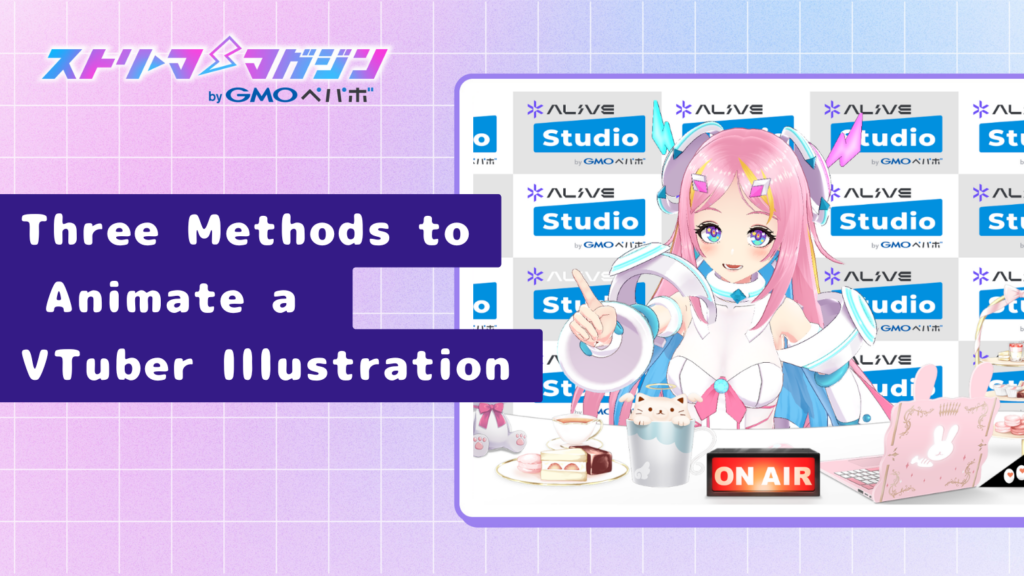
Even if you say “animate an illustration,” there are actually several levels. You don’t have to start with a difficult method. Start with what you can do and gradually step up.
Here, we introduce three methods in order of difficulty so that beginners can easily choose.
① Easiest! Manually Switching Expression Variants
The easiest method is to prepare various expression images in advance and switch them during streaming. Prepare a smiling face, surprised face, closed eyes, etc., and simply turn the image sources on and off in OBS. By setting hotkeys, you can switch with just one touch.
While there is no actual movement, simply changing the expression significantly improves the impression of your stream. This method is perfect for those who just want to establish their stream and don’t want to struggle with settings.
② Animate with Still Images + Voice Reaction
The next stage is to switch images in response to your voice. When you speak, the image changes to one with an open mouth. Even that makes it much more VTuber-like.
This method can be achieved by utilizing OBS plugins or external tools. Additionally, services like Discord’s Reactive Images can automatically switch images according to speech during calls.
Some configuration is necessary, but you usually don’t need a large-scale environment setup. Think of this as a step beyond manual switching.
③ Naturally Animate with 4 Expression Variants + PNGTuber
If you want to go a little more professional, the combination of variant images and PNGTuber tools offers a well-balanced approach. Preparing four images for open/closed eyes and open/closed mouths makes it easy to express blinking and lip-sync simultaneously.
However, it’s not mandatory to have four images. Depending on the tool, movements can be added with two or even a single image. Starting with a manageable number of images is no problem.
Furthermore, using PNGTuber tools allows you to add light shaking and reactive effects. In many cases, you don’t need the detailed preparation of dividing parts like Live2D, making it an approachable method for beginners.
This method is the most realistic choice for those wanting to continually stream. Without overburdening yourself, yet achieving a good appearance—it sits perfectly between beginner and pro levels.
First, organize what level of movement you are aiming for.
Do you want to simply start streaming, or animate fully? Once that’s decided, the method you should choose will naturally become clear.
Points to Keep in Mind Before Animating an Illustration
Before learning how to animate, first focus on laying the groundwork. If you proceed without clarifying the basics, you may encounter minor troubles like not moving smoothly, not being transparent, or poor image quality.
Just a little fine-tuning will make subsequent tasks much easier.
Let’s confirm these points in order.
Understanding Transparent PNGs, Recommended Sizes, and Resolutions
As a basic rule, you should use PNG format with a transparent background. If the background remains white or a single color, a square frame will be visible when placed on the streaming screen. A transparent background will blend naturally with the game screen or background material.
Size is also a crucial point. Stretching a small image too much will cause blurring, while an overly large image can burden your PC.
As a guideline, prepare a size slightly larger than how it will actually be displayed during streaming. Some tools suggest that 1024px to 2048px is manageable. Focus on an appropriate size rather than preparing excessively large images.
Preparing clean data initially will stabilize later settings considerably.
How Many Variants Are Needed? Differences by Method
“Variants” refer to images with different expressions or mouth openness. The term “4 variants” is commonly heard.
Open and closed eyes, open and closed mouths. Having these 4 allows for natural expression of both blinking and lip-sync.
It’s not a strict requirement to have 4 images. Just open and closed mouths can work with 2 images, and some tools can create movement with a single image.
The number of images required depends on the method you choose. Decide on the method first, then prepare the variants to avoid waste.
Basic Mic Settings and Audio Input
If you plan to animate based on voice reaction, microphone settings are crucial. If the input is too low, it won’t react; too high, and the mouth will constantly remain open.
Start by confirming that your input device is correctly selected in OBS or the tool you’re using. Then, adjust the input sensitivity and thresholds. Aim for a state where it reacts when you speak and stays closed when silent.
If refined carefully, the naturalness of the movement will improve significantly. Prioritize tuning the audio before focusing on other tools. Surprisingly, this is the key point.
Once you’re ready, it’s time to actually animate. Next, we’ll explore specific methods to display and animate illustrations in OBS.
How to Easily Animate Illustrations in OBS [Hotkey Switching]
Once you’re ready, it’s time to configure OBS. Though it might seem difficult, what you need to do is surprisingly simple.
First, display, then switch, and finally, react. If you proceed in this order, you’ll avoid confusion.
Here, we’ll explain how to animate using OBS.
Basic Steps to Display a Still Image in OBS
The first task is to display the illustration on the streaming screen.
Open OBS and create a scene. Next, from the source section, click “+” to add an image and select the PNG file of the illustration. It will then be displayed on the screen.
You can move it by dragging within the red frame. Resize by dragging the corners or edges of the frame. Adjust while checking the display balance.
In game streaming, positioning it at the edge of the screen often makes it easier to see. Adjust while considering the overall balance.
If you can manage this much, that’s okay. Even without movement, your stream will be established.
How to Switch Expression Variants Using Hotkeys
The next step is to be able to switch expressions.
The method is simple. Add image sources for each expression and manage them by toggling visibility. With OBS hotkey settings, you can switch with just one button press on your keyboard.
For instance, display the normal expression constantly, and only show the surprised expression briefly with a specific key. Such usage is also possible.
Even without actual movement, just changing the expression significantly alters the impression of the stream. Mastering this step first is reassuring.
Once you’ve learned how to animate expression variants in OBS, next we’ll look at further animating with Discord integration and PNGTuber.
For Call Streaming! How to Animate Illustrations with Discord Integration
If you frequently do collaborative streams or chat streams while calling, Discord integration is an option. The mechanism is simple. It automatically switches pre-prepared images according to the state of the person speaking.
This method differs slightly from completing everything within OBS, as it involves using external services and importing them as browser sources. While some preparation is needed, the settings aren’t too difficult once you get used to it.
Let’s go through the steps in order.
How Discord’s Reactive Images Work
Using the Reactive Images feature, you can switch images only while speaking. For example, normally it displays a closed-mouth image, changing to an open-mouth image only when you speak.
The process involves registering images for the normal and speaking states, and simply inputting the issued URL as a browser source in OBS. As soon as you’re recognized as a speaker in a Discord voice channel, the images for Inactive and Speaking automatically switch.
Two images are sufficient to make this work. Though simple, it surprisingly looks natural during streams.
How to Import Reactive Images into OBS
Once set up, add a browser source in OBS. Enter the URL provided by Reactive Images and adjust the display size.
If you want a transparent background, you can either set it up for transparency on the browser source side or use OBS’s chroma key function to remove a specific background color as needed. You can adjust the display position like any image source.
Once set up, illustrations will react according to speech during calls. This method is particularly compatible with collaborative streams.
When Discord Integration is Suitable/Not Suitable
This is suitable for call-centered streaming styles. In collaborative or chat streams, it becomes easier to determine who is speaking.
On the other hand, if streaming alone is your focus, PNGTuber tools might offer more detailed movements. If you want added movements like shaking or blinking, other methods might offer more flexibility.
There’s no single correct method. The main criterion is whether the method suits your streaming style.
Let’s next explore the natural movement method using 4 image variants + PNGTuber.
Naturally Animate with 4 Variants + PNGTuber
If you wish to raise the quality further, combining 4 image variants with PNGTuber tools is recommended. Although it doesn’t require as much effort as Live2D, the natural appearance improves significantly.
It’s simple: prepare variants, load them into the tool, and display them in OBS. Let’s go through this step-by-step.
Creating 4 Variants (Eye and Mouth Combinations)
The basics are the combination of open/close eyes and open/close mouths.
– Open eyes + closed mouth
– Open eyes + open mouth
– Closed eyes + closed mouth
– Closed eyes + open mouth
These 4 images allow easy expression of speaking movements and blinking simultaneously. The addition of blinking brings a much more lively feel to the illustration.
Of course, having 4 images isn’t strictly necessary. Starting with just 2 images for open/closed mouths is fine. Adding blinking if capable is a gradual method that works well.
Basic Settings for PNGTuber Tools (Example with Veadotube Mini)
Representative PNGTuber tools operate by registering images for normal and speaking states, automatically switching them in response to microphone input.
Here’s a basic flow using Veadotube Mini as an example.
- Loading Images Launch Veadotube Mini and add images for normal and speaking states via the character settings screen. Start with just 2 images: a closed mouth and an open mouth.
- Select Microphone Input Device Select the microphone you will use via the settings screen. Choosing the same one as OBS makes it easier to check the behavior during streaming.
- Adjust Sensitivity Adjust the microphone sensitivity slider to set how loudly you need to speak to open the mouth. Aim for a state where it closes when silent and opens only when talking.
- Display in OBS In a Windows environment, use Spout2 Capture or Game Capture (with transparency enabled) for importing. Window capture might not handle transparency well, so choose an appropriate capture method if you wish to layer with transparency.
If the sensitivity is too low, it won’t react, and if too high, the mouth might stay open. Spending a bit of time here yields a significant improvement in results.
Tips for a More Natural Look (Shaking, Blinking, Combinations)
Once you’re comfortable, try adding eye-opening and closing to create 4 variants. Just adding a blink changes the impression significantly.
Additionally, adding light shaking or jumping effects based on microphone reaction can reduce the static feeling and make it more natural. Combining audio reaction with hotkey-based expression switching is also recommended.
These measures can make your illustration appear quite animated even without Live2D. It’s a balanced method, ideal for those before stepping into Live2D.
For more in-depth information on PNGTuber, check out the article below:
>>PNGTuber Guide: How to Start, Recommended Tools & Differences from Vtubers
Finally, let’s go through common troubles and their solutions.
Troubleshooting When Illustrations Don’t Animate Well [Common Issues]
This section is for those animating illustrations with PNGTuber tools like Veadotube Mini, summarizing common sticking points.
Causes often differ from manual expression switching or Discord integration. As such, this should provide clarity for troubleshooting voice reaction types of issues.
Mouth Stays Open
The most common cause is the microphone sensitivity being too high.
Picking up ambient noise constantly keeps it in a speaking state. Start by decreasing the sensitivity slightly. Check if it reacts to keyboard keystrokes or air conditioning sounds.
Furthermore, if settings for microphone input, sensitivity, or noise filter in Veadotube Mini aren’t matched, it might continue reacting even when silent. First, review settings in the tool, and if still concerned, checking OBS filter settings or audio pathways makes it easier to narrow down.
No Reaction at All
There likely isn’t any sound input.
Ensure the microphone being used is correctly selected in the PNGTuber tool. Although it might be inputting sound in OBS, sometimes another device is selected in the tool.
Try reopening the microphone list to reselect. Surprisingly, that might fix it.
Background Isn’t Transparent
Even with a transparent PNG, the background might turn black or white depending on the import method.
Window capture might not handle transparency well. Confirm you’re using methods like Game Capture or Spout2 that support transparency.
If the background still doesn’t disappear, you can also use a chroma key to remove a specific background color.
Movement Looks Unnatural
Sensitivity adjustments might be off. If the reaction to voice volume extremes, the mouth might open and close too much.
Also, if the blink interval is too short or too long, it can appear unnatural. Gradually adjust values to find settings that match your speaking style.
Conclusion
You don’t have to start with a difficult method to move an illustration. The key point is choosing a method that suits your streaming style and current skills. Start from what you can do, and you’ll naturally step up.
If you want to start quickly, it’s recommended to display an illustration in OBS and switch expression variants with hotkeys. Even if there’s little movement, just changing expressions greatly improves the atmosphere of the stream.
For those who do a lot of collaborative or call streams, Discord integration is a well-suited option. Images switch according to the speaker, making it visually easy to determine who’s talking.
If you want a more professional look, 4 variants + PNGTuber tools are the perfect balance. With the addition of blinking and shaking alongside lip-syncing, even an illustration can appear lively. If you encounter a problem with settings, the cause is usually one of the mic, sensitivity, or import method. Calmly narrow down each one, and you’ll be okay.
The important thing is not to aim for perfection. First, you got it moving, and successfully streamed. That experience will lead to the next improvements.
Start VTuber-ing with a single illustration from a method you can manage.