

Share


How to Create a VTuber Like ‘Konna Kanji Test’: A Step-by-Step Guide for Beginners

The “VTuber For Example Test” videos you see on social media timelines. Have you ever thought, “I want to create one of those short videos that quickly showcase my appeal”?
However, when you try to start, you might wonder, “Where do I get the sound source?” or “How do I edit the video?” and find it difficult to take the first step.
In this article, we will clarify the procedure from obtaining the sound source for “VTuber For Example Test” videos to editing and posting on various social media so you can complete it without getting lost, even if it’s your first time.

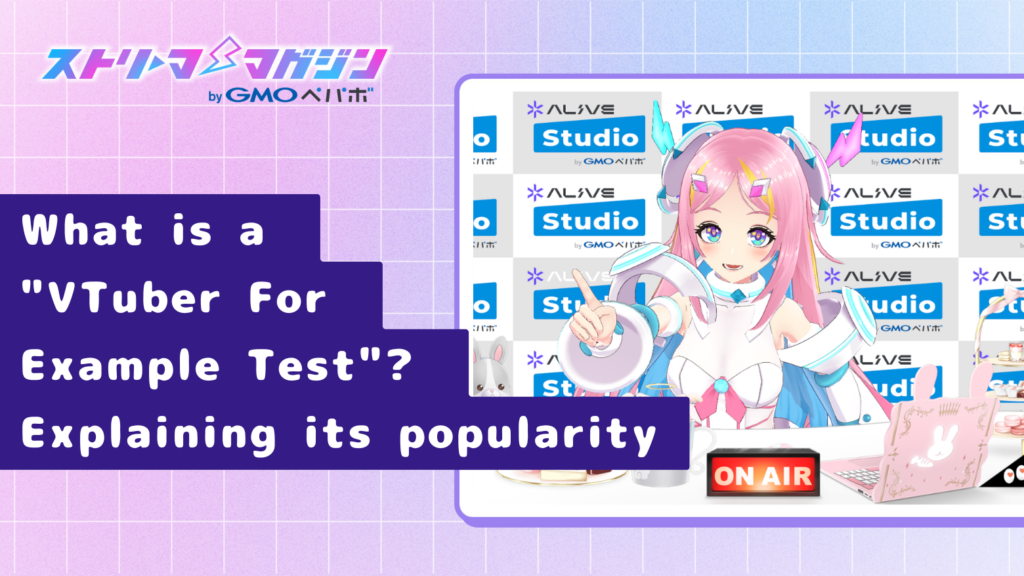
What is a “VTuber For Example Test”? Explaining its popularity
First, let’s understand what a “For Example Test” video is by getting down to the basics.
Format and Purpose of “For Example Test” Videos
“For Example Test” is a short video format where VTubers introduce their characters in sync with a short piece of music. The goal is to showcase oneself briskly, with “This is how my upper body looks, and this is how my voice sounds!” to capture the audience’s interest at a glance. It has become a standard project for self-promotion right after a new VTuber’s debut.
The song used in these videos is an original piece composed by HappyPizzaBread. The original video was initiated by Rimi, a VTuber from V-LUP, who performed the vocals for the sound source and posted it on her channel.
This quickly spread across the VTuber community, and many creators began posting videos using the same sound source.
Reasons for Its Popularity: “Ease of Participation” and “Ease of Spread”
There are two main reasons why this format has become so widespread.
The first is ease of participation. The sound source is distributed for free, and the video structure is simple, so anyone with a Live2D model can try it out right away.
The second is ease of spread. Short videos of about 30 seconds to 1 minute are easy to watch until the end, and using hashtags like “#ForExampleTest” and “#NewVTuber” makes them searchable as a set, giving newcomers with few followers a chance to been seen by many people.
Let’s see what you need to actually make this video from here.
List of Things Needed for Making “For Example Test” Videos
Before you start making a video, make sure to check the necessary tools and materials. Everything can be obtained for free, so no need to worry about costs.
Live2D Model and Tracking Software
First and foremost, you need a Live2D model that will be your avatar. Prepare one yourself or commission an illustrator or modeler to create one for you.
To animate the model, you’ll need tracking software. VTube Studio is a typical choice; it uses your PC’s webcam or smartphone camera to reflect facial expressions and movements in real time. It is free to use and stable, making it a favorite among many VTubers.
For more on how to create Live2D models and tracking software, refer to the detailed explanation in the following articleBeginner’s Guide to Creating VTuber Avatars: Free Live2D & 3D Tools
Recording Software and Microphone
To capture the movements of the Live2D model as a video file, use recording software like OBS Studio. With OBS, you can capture VTube Studio’s footage using game capture, enabling recording with a transparent background. You can also simultaneously record speech, capturing dialogue as well.
For more about using OBS Studio, refer to the detailed explanation in the article below:
OBS Studio Guide: Basics to Streaming & Recording for BeginnerIf you’re including voice, it’s recommended to prepare a USB condenser microphone to ensure clear sound quality. Also, adjust noise reduction settings for peace of mind.
For microphone settings in OBS Studio, refer to the following detailed guide:
OBS Studio Microphone Setup Guide: Achieve High-Quality Audio EasilyVideo Editing Software
Prepare editing software to process and finalize your recorded material into a single video. Here are two recommended options:
- CapCut: A free app usable on both smartphones and PCs. It features many templates and intuitive operation
- DaVinci Resolve: A professional-grade free software. It offers abundant features for color correction and audio editing, perfect for those who want to focus on details
Both offer ample free functionality, so choose the one that suits you best.
How to Download the Sound Source and Rules for Credit Notation
The audio and video assets for “For Example Test” are available for free download from the description section of the video on Rimi’s YouTube channel. In addition to the original track and instrumental version, the package also includes video project files and green screen footage, all ready to use for your own edits.
When posting, it’s recommended to use the “Remix” feature on YouTube Shorts and the “Use Sound” feature on TikTok. Be sure to include credits, as registering sound sources under a different name without permission is strictly prohibited.
Once you’re prepared, let’s start making the video.
How to Create a “For Example Test” Video [5 Steps]
Once you have what you need, let’s make the video. By following these five steps, even first-timers can reach completion without confusion.
STEP1|Listen to the Sound Source and Decide on the Structure
First, listen to the downloaded sound source several times to grasp the flow of the music. Then decide on “what to show and when” based on that.
For instance, start with “close-up of the face → full body → voice → signature pose”, and note the order to show for a smooth process. Placing highlight scenes in sync with the song’s chorus or transition points results in a well-paced video.
STEP2|Record the Movement of the Live2D Model
Once you dec有ide on the structure, use OBS Studio to record the movement of the Live2D model. Setting the background to transparent in VTube Studio and capturing it with OBS game capture completes the setup.
If your model has expression variations or pose swaps, registering them in VTube Studio’s hotkeys makes shooting smoother. You don’t need to capture everything perfectly in one take; record multiple takes and later connect the best parts.
STEP3|Align Sound Source and Video in Editing Software
Import the recorded video and sound source into editing software and align them on the timeline. The key here is syncing. Cutting the video in time with the beats or ends of lyrics creates a pleasant rhythm for viewers to watch.
Displaying the waveform allows you to see the beats visually, so placing cut points there is a technique to master.
STEP4|Add Captions and Effects
Once the video and sound source are aligned, add captions and effects to finalize the video. Adding subtitles like “This is how my upper body looks!” helps the content to get across even if it’s played without sound.
Adding transition effects during scene changes or zooming in on key scenes makes the video more engaging. However, be cautious not to overdo it, maintaining simplicity.
STEP5|Export Settings and Final Check
When editing is complete, export using settings suitable for short videos. The resolution should be 1080×1920 (vertical full HD), with a frame rate of 30fps as a base guideline. MP4 is generally a safe choice.
Transfer the exported video to your smartphone and watch it to ensure text is readable, sound is clear, and the pacing feels right. If everything’s fine, you’re ready to start preparing for posting.
5 Tips to Enhance Video Quality
Once you know the basic process, aim for quality improvement. With some tweaks, you can drastically change the impression of the video.
Add an Eye-Catching Effect in the First Two Seconds
In short videos, the first two seconds are critical. If you can’t capture interest here, people will swipe away. Start with an up-close of the model or lead with an impactful line to make viewers wonder, “What is this?”
Show the Live2D Model in the Order: Up-Close → Full Body → Signature Pose
Keeping the same composition on screen tends to lead to monotony. To avoid boredom, start with a close-up, then show the full body, concluding with a signature pose. If your model has expression variations like winks or surprise faces, use them at key moments for better effect.
Cut to the Beat of the BGM
Editing to synchrony with the rhythm of the music creates a pleasing viewing experience. By displaying the waveform in the editing software and placing cut points at prominent beat locations, you achieve this technique. While initially may seem tedious, mastering “audio sync” rapidly amplifies your video’s professional feel.
Make Subtitles Bold and Large, and Place Within Safe Areas
Subtitles rely on readability. Choose a bold, Gothic-style font, apply background color or outlines for improved legibility.
Placement is key as well. If you place subtitles too close to the screen’s top or bottom edges, they can be obscured by TikTok or YouTube Shorts buttons. Leave a margin above and below, positioning subtitles nearer the center for safety.
Balance Sound Levels of Voice and BGM
It would be a shame for your voice to be drowned out by the BGM. As a guideline, set voice levels around -6dB, and BGM about -20dB, resulting in a balance where your voice stands clear.
Fine-tune while gauging through the editing software’s audio meter, and finally verify that it’s audible via smartphone speakers. Testing exclusively with headphones can alter perceptions on smartphone playback.
Key Points for Posting on YouTube, TikTok, and X
Once the video is complete, post it on various social media to get it seen by many people. Each platform has specific points to note, so we’ll check them one by one.
YouTube Shorts
When posting on YouTube Shorts, videos need to be vertically formatted (9:16) and under three minutes to be categorized as “shorts”. A recommended length is around 30-60 seconds. Including hashtags like #ForExampleTest, #VTuber, and #NewVTuber in titles or descriptions helps in making them discoverable through search or related videos.
For using sound sources, it’s best to use the “Remix” function as recommended by the original creator. If reposting videos made for other platforms, note that carrying over watermarks could disadvantage YouTube’s algorithm, so always upload from the original video files.
TikTok
On TikTok, shorter videos around 15-30 seconds are particularly favored. By using the “Use Sound” feature recommended by the original creator, your video is grouped with others using the same sound, expanding chances for virality.
Immediate reactions post-upload greatly impact virality, making timing crucial. Aim for your followers’ active periods, and push initial plays by announcing releases through X, etc.
X (formerly Twitter)
When posting videos on X, direct uploads are recommended. Simply posting a YouTube link may lead to overlooking as the preview might not display properly in timelines.
As most video autoplay on X occurs muted, subtitles benefit videos. Add #ForExampleTest in posts along with engaging snippets that draw interest. If resources allow, pin the post for profile visitors to increase visibility.
Common Mistakes by Beginners and Solutions
Finally, here’s a summary of mistakes commonly made when creating videos for the first time. Being aware beforehand helps avoid them, so check before posting.
BGM Too Loud, Drowning Out the Voice
This is the most frequent mistake by beginners. If you use BGM at original levels, it can drown out your voice. Adjust BGM volume in editing software to ensure your voice is clearly heard. To confirm, check with both the smartphone speaker and earphones.
Reposting TikTok Watermarked Videos to YouTube
Some may save their “For Example Test” videos from TikTok and directly upload them to YouTube Shorts.
However, videos downloaded from TikTok automatically contain TikTok logo watermarks. When reposted, the algorithm penalizes them as cross-platform copies. If you wish to share them on YouTube, use the original video files without watermarks exported directly from the editing software instead of TikTok downloads.
Subtitles Overlapping with Smartphone UI, Making Them Unreadable
Even if text looks perfect during editing, UI buttons on TikTok or YouTube Shorts can overlap with subtitles when played on a smartphone. Hence, take care with lower screen areas displaying app buttons or comment bars. Centralize subtitles, and develop the habit of confirming through smartphone previews before the final upload.
Conclusion
“VTuber For Example Test” videos are a beginner-friendly format due to their simple composition and free distribution of sound sources, ideal for newcomers to video creation.
Focusing on syncing cuts with the beat and placing captions thoughtfully enhances the quality dramatically. With the mindset of “Let’s make one and post it first!” challenge yourself. Hopefully, this article has been a helpful reference for your video-making journey.